How to make a restaurant menu that works
A good menu is more than a list of dishes and prices. It tells guests what to choose, explains Greek dishes to tourists and is easy to change during the season. Here you'll find the structure, examples and a template you can download for free.
Free, no sign-up. The Word file also opens in Google Docs.Updated: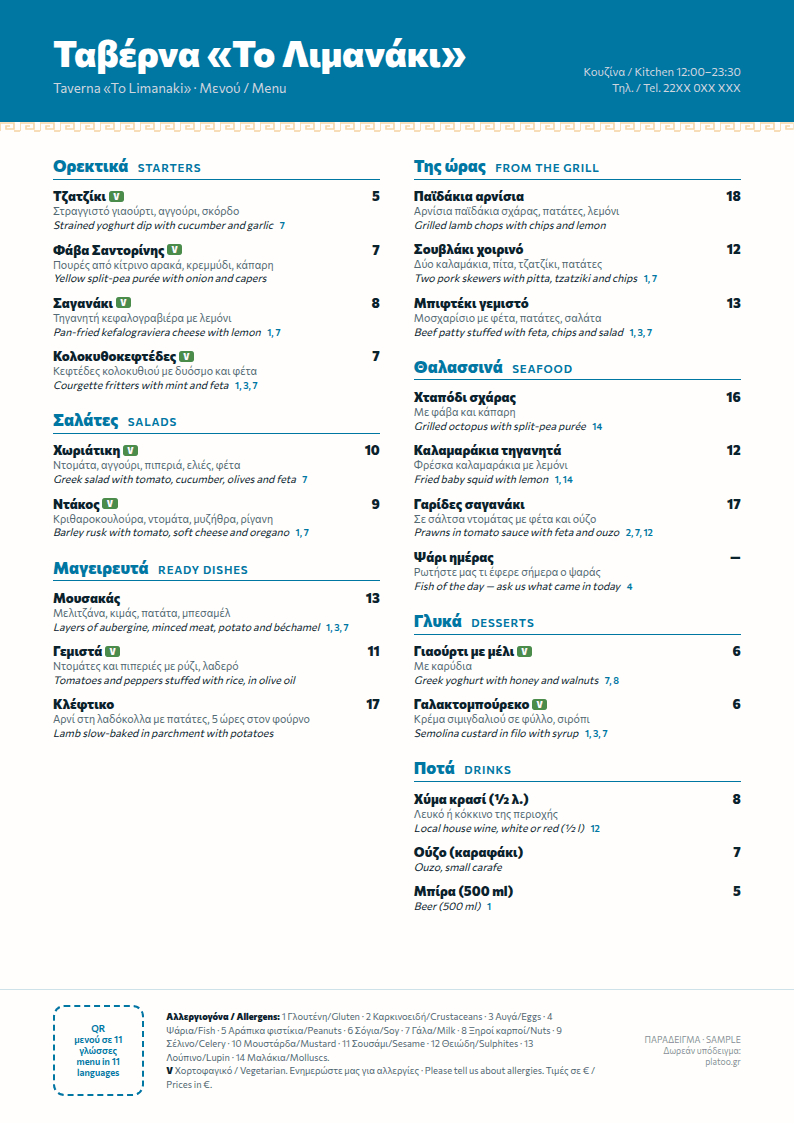
What a good restaurant menu includes
Whatever you serve, guests look for the same things on a menu. If one is missing, they ask the waiter — or order something "safe".
- 1
Venue name and details
Logo or name at the top, kitchen hours and phone at the bottom. Guests who photograph the menu will remember you.
- 2
A few clear categories
Starters, salads, mains, desserts, drinks. In the order guests eat, not the order the kitchen cooks.
- 3
Dish names guests understand
Keep the Greek name — moussaka, kleftiko — with a short explanation underneath for anyone who doesn't know it.
- 4
A short description
One line: what it is, how it's cooked, what makes it yours. Not a list of every ingredient.
- 5
Prices in one format
The same format everywhere (12.50), next to the dish. For dishes priced by weight or by the day, say clearly how they're charged.
- 6
Allergens
Information on the 14 allergens is mandatory across the EU. A number or icon next to each dish is enough, with a key at the end.
- 7
Dietary labels
Vegetarian, vegan, gluten-free. Tourists look for these first — and Greek ladera dishes already qualify.
- 8
Languages
In a tourist area a menu needs English at least. For German, French and Italian guests, their own language is even better.
The order of categories guests expect
Guests read a menu from top to bottom and decide fast. List categories in the order of the meal and put the dishes you want to sell at the top of each one.
Taverna / restaurant
- 1Starters / meze
- 2Salads
- 3Ready dishes (mageirefta)
- 4Grill / cooked to order
- 5Seafood & fish
- 6Desserts
- 7Wine & drinks
Put the fish of the day in a separate box so it can change without reprinting the whole menu.
Café
- 1Coffee (hot / iced)
- 2Tea & other drinks
- 3Breakfast
- 4Sandwiches & toasties
- 5Cakes & sweets
- 6Juices & smoothies
- 7Soft drinks
Explain freddo espresso and freddo cappuccino — many foreign guests don't know what they are.
Beach bar
- 1Cocktails
- 2Beer & wine
- 3Coffee
- 4Juices & soft drinks
- 5Snacks & salads
- 6Fruit & ice cream
You sell different things in the morning and at night. Two short menus work better than one long one.
Dish descriptions that help guests choose
A description is your waiter on paper. One line is enough, as long as it answers what guests would ask.
- 1What it is (meat, fish, vegetables)
- 2How it's cooked (grilled, oven-baked, in olive oil)
- 3What makes it yours (where from, whose recipe)
- BeforeKleftikoAfterKleftiko
Lamb slow-baked in parchment with potatoes, garlic and oregano — 5 hours in the oven - BeforeGemistaAfterGemista
Tomatoes and peppers stuffed with rice and herbs, baked in olive oil — vegetarian - BeforeSaganaki cheeseAfterSaganaki
Pan-fried kefalograviera cheese with lemon — from a dairy on Naxos
- Skip "amazing" and "delicious": guests want to know what they'll eat, not how much you like it.
- Mention origin where you can: local cheese, fish from the village fisherman, wine from the area.
- Keep descriptions the same length. If one dish gets three lines and the rest get one, guests think something is off.
How to show prices
Price is the most sensitive information on a menu. Small changes in how you write it change what guests order.
- 1
Price after the description
When the price ends the description, guests read the dish first. When all prices sit in a column on the right, they choose from the column.
- 2
No dotted lines to the price
Dot leaders (Moussaka ........ 12) pull the eye straight to the number. A space is enough.
- 3
Fewer "€" signs
In a Cornell study (2009) guests spent more when prices were written as plain numbers, without a currency sign. One "Prices in €" line at the bottom is enough.
- 4
One format
12.50 or 12.5 — pick one and keep it everywhere. Round prices (12) read calmer than 11.90.
- 5
One expensive anchor dish
An expensive dish at the top of a category makes the rest look reasonable. A platter for two works well for this.
Cornell Center for Hospitality Research: $ or Dollars? (2009)
Menus for tourists: what they look for and what they don't get
In the Greek season a menu is read in ten languages. Tourists know a handful of Greek dishes and order those unless you explain the rest.
Keep the Greek name
Write "Kleftiko", not "Thief's lamb". Tourists look the name up on Google and want to find it on your menu.
33 dishes in 4 languages →Explain the "invisible" dishes
Octopus, kalamarakia, paidakia: few people abroad search for them. One line of explanation gets them ordered.
The 5-country study →Allergens in every language
A tourist with an allergy won't take risks. Numbers or icons work in every language.
The 14 allergens →Photos for the unfamiliar
A photo explains soutzoukakia better than three lines. Add photos to the dishes guests don't know, not to all of them.
How many dishes should a menu have
There's no magic number. But three rules hold almost everywhere.
5–8 dishes per category
More tires both guests and the kitchen. If a category keeps growing, split it in two.
Cut what doesn't sell
At the end of each month, check what was ordered. A dish that neither sells nor makes money comes off the menu.
Reuse ingredients
The same core ingredients across several dishes mean less waste and a faster kitchen at peak time.
Printed or QR menu?
It isn't either-or. Many venues keep a printed menu with a QR next to it. The difference shows during the season.
| Printed menu | QR menu | |
|---|---|---|
| Changing a price | Reprint | From your phone in 1 minute |
| Languages | 1–2 on paper | 11 languages, automatically |
| Photos | A few, costly to print | As many as you like |
| Dish of the day | Board or insert | Change it any time |
| Allergens | Key at the end | Icons on every dish |
| Cost | Design + print every season | Free on the Free plan |
A QR menu doesn't replace the waiter. It just saves them from explaining the same dish ten times a day.
Make your menu in 7 steps
- 01
List every dish
In a document or the template, with price and ingredients.
- 02
Cut and group
Remove what doesn't sell. Put the rest into 5–7 categories.
- 03
Order
Categories in meal order. Within each, the dish you want to sell first.
- 04
Write descriptions
One line per dish: what it is, how it's cooked, what makes it yours.
- 05
Mark allergens and diets
Numbers 1–14 for allergens, labels for vegetarian and vegan.
- 06
Translate
English at least. Keep Greek dish names and translate the description.
- 07
Print or go QR
Print the menu or upload it as a QR menu — or both.
Free restaurant menu template
Two files to get started: a Word template you fill in with your own dishes, and a finished taverna menu in PDF so you can see how it all fits together.
- Taverna categories in the right order
- Space for a description and price for each dish
- Greek and English side by side
- Key for the 14 allergens
- Space for a QR code at the bottom
From a Word file to a tourist's phone
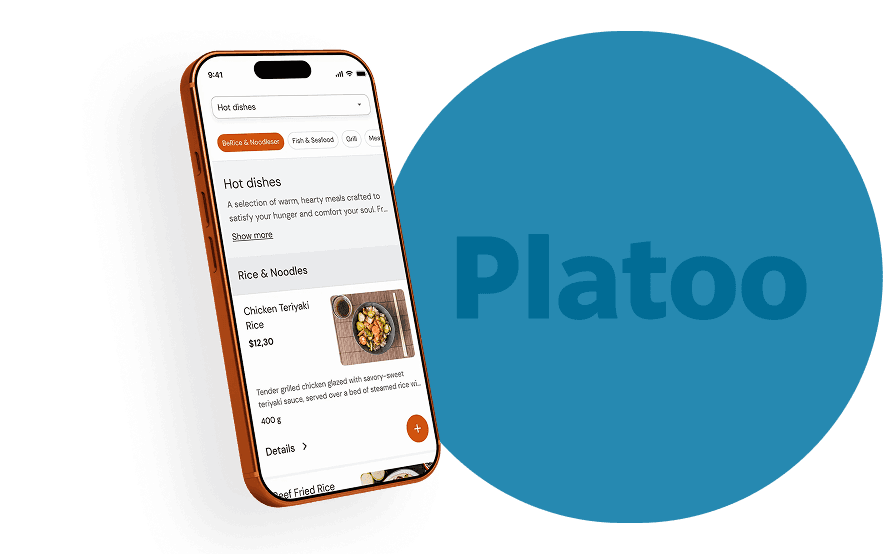
When your menu is ready, upload it to Platoo. It's translated into 11 languages, shows allergens as icons and changes from your phone during the season.
- Free forever on the Free plan
- Or send us your menu on Viber or WhatsApp and we set it up
- One QR code for the whole season
Frequently asked questions
What should a restaurant menu include?
The venue's name and details, categories in meal order, a name and short description for each dish, the price, allergens and labels for vegetarian or vegan dishes. In a tourist area, at least an English translation too.
How many dishes should a menu have?
A practical rule is 5–8 dishes per category and 5–7 categories. A shorter menu means faster decisions for guests and less waste for the kitchen.
Is there a free restaurant menu template in Word?
Yes. On this page you can download a free restaurant menu template in Word (it also opens in Google Docs) and a finished taverna menu in PDF, in Greek and English.
What software can I use to make a restaurant menu?
For a printed menu, Word or a design tool like Canva is enough. For a digital QR menu, a platform like Platoo lets you enter dishes once while the menu is translated and updated online.
Which languages should a menu for tourists be in?
English at least. If you get many German, French or Italian guests, a menu in their language helps them order beyond the familiar dishes. Keep the Greek dish names.
How do I write a dish description?
In one line: what it is, how it's cooked and what makes it yours. For example: "Lamb slow-baked in parchment with potatoes and oregano". Avoid generic words like "delicious".
Is a printed or a QR menu better?
A printed menu is familiar to everyone. A QR menu wins when you change prices often or need many languages or photos. Many venues in Greece keep both.
Your menu, in every language
Upload your menu to Platoo or send us a photo of it on Viber or WhatsApp. Your QR menu is ready in 24 hours.